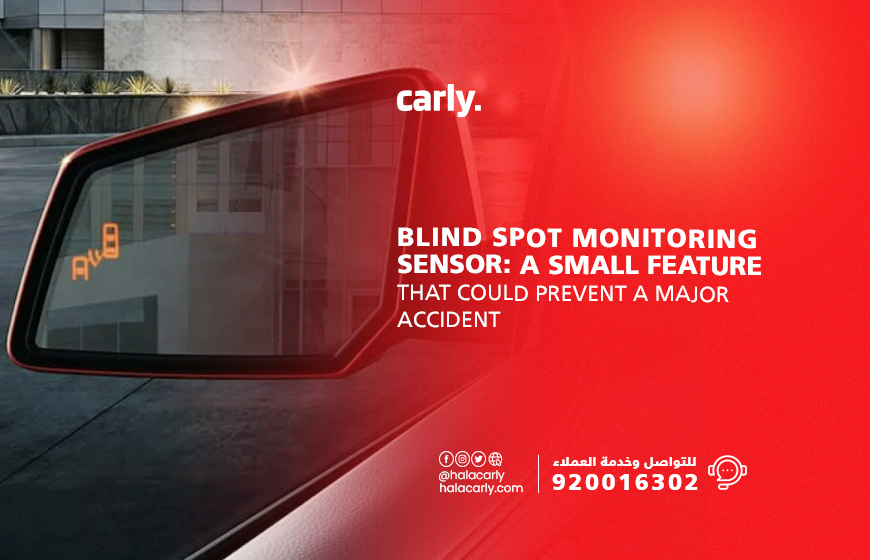
Blind Spot Detection Sensor: A Small Feature That Can Prevent a Big Accident
The blind spot detection sensor is one of the most important systems that has become essential in many modern vehicles, as it assists the driver in handling frequent and potentially dangerous situations — such as the presence of a vehicle in an area not clearly visible in the side mirrors. Therefore, when buying a new or used car, the decision is no longer based solely on engine power or exterior styling; safety level has become a fundamental part of the purchase decision.
Through the Carly website and app, anyone searching for a car in Saudi Arabia can compare available vehicles based on specifications, safety systems, interior and exterior features, and pre-purchase inspection services. This helps buyers choose a car that not only fits their budget but also matches their driving style and safety needs on the road.
How Does the Blind Spot Detection Sensor Work While Driving?
The blind spot detection sensor is considered one of the most important driver-assistance safety systems. It is designed to monitor the rear-side areas that may not be clearly visible in the mirrors, especially when changing lanes or overtaking. These areas are known as “blind spots” because they fall outside the driver’s direct line of sight, where a nearby vehicle may briefly disappear even while the driver is checking the mirror.
The blind spot problem occurs because mirrors do not reveal the entire surrounding area of the car, even when properly adjusted. The issue becomes more apparent on highways, when driving alongside trucks and large vehicles, or when driving SUVs and pickups with larger bodies and wider viewing angles. In such situations, a driver may believe the adjacent lane is clear when, in fact, a nearby car is positioned in a hard-to-notice spot.
The blind spot detection sensor typically works through radars or sensors integrated into the rear of the car near the bumper or rear sides. These sensors monitor vehicle movement in adjacent lanes, and when a car enters the danger zone, a visual alert appears on the side mirror. If the driver activates the turn signal in the same direction, the warning may intensify — flashing or producing an audible alert depending on the car’s configuration.
The importance of this system lies in the fact that it does not drive the car for the driver, nor does it eliminate the need for using mirrors or turning to look when necessary. However, it provides an additional alert at a moment when the decision to change lanes can be quick and critical to safety.

Forms of Blind Spot Sensor Alerts
The blind spot detection sensor doesn’t operate the same way in every car, as the alert method differs depending on the manufacturer, the car’s category, and the level of safety systems available. However, the goal remains the same: to alert the driver when a vehicle is in an area that is difficult to see clearly before changing lanes. Below are the various forms of alerts:
Visual alert in the side mirror — One of the most common forms of alert, where a small illuminated sign appears on the side mirror when a vehicle is in the blind spot. The advantage of this alert is that it appears in a location the driver naturally looks at before changing lanes.
Flashing when the turn signal is activated — If the driver activates the turn signal in the same direction as the vehicle in the blind spot, the steady light may turn into a clearly visible flash. This alert is considered stronger because it appears precisely when the likelihood of a lane change is greatest.
Audible alert inside the cabin — Some cars produce a short warning sound if the driver attempts to change lanes while another vehicle is nearby on that side. This alert is useful when the driver doesn’t notice the visual warning on the mirror.
Steering wheel or seat vibration — In some higher-trim levels, the driver may feel a slight vibration in the steering wheel or seat when there is a side hazard. This type stands out as a direct sensory alert, especially when the cabin is noisy or the driver is distracted.
Side camera display on the screen — Some modern cars don’t stop at alerts; they display a live view of the right or left side when the turn signal is activated. This helps the driver see the adjacent lane more clearly, particularly in cars equipped with a blind spot camera.
Warning message on the instrument cluster — A warning or icon may appear on the instrument cluster screen when a vehicle is in the side area or when there is a problem with the system itself. This type is useful for alerting the driver to the system’s status, whether functioning properly or in need of inspection.
Integration with other safety systems — In some advanced cars, the blind spot sensor works in conjunction with systems like lane-keeping assist or rear cross-traffic alert. This makes the warning more comprehensive, especially when reversing out of a parking spot or transitioning between lanes.
Alert intensity varies with risk level — In some systems, the warning is not always at the same intensity. It may begin as a simple visual alert when a car is alongside, then intensify if the turn signal is used or if the vehicle starts drifting toward the adjacent lane.
ابحث عن سيارة أحلامك الآن!
آلاف السيارات الجديدة والمستعملة بأفضل الأسعار. تصفح، قارن، واشتري بكل سهولة من خلال منصة كارلي الموثوقة.
The Difference Between a Blind Spot Sensor and a Blind Spot Camera
Some may think the blind spot detection sensor is the same as a blind spot camera, but there is a difference between the two systems. The blind spot detection sensor relies on sensors or radars to alert the driver when a vehicle is in the rear-side area.
The blind spot camera, on the other hand, displays an actual image of the right or left side of the car on the screen, and typically activates when the turn signal is used.
In other words, the sensor gives you a warning, while the camera gives you additional vision. Some cars combine both systems, displaying a side image alongside a visual or audible alert depending on the trim level and configuration.
Below is a table illustrating the difference between the blind spot detection sensor, the blind spot camera, and other related safety systems:
Table: The Difference Between Safety Systems Related to the Blind Spot Sensor
| System | Primary Function | When Does It Help the Driver? |
|---|---|---|
| Blind Spot Detection Sensor | Alerts the driver when a vehicle is in the non-visible area | When changing lanes or overtaking |
| Blind Spot Camera | Displays a side image of the road next to the car | When the turn signal is activated |
| Lane Keeping Assist | Alerts or assists the car to stay within its lane | During unintentional drifting |
| Rear Cross-Traffic Alert | Warns the driver of vehicles approaching from the sides while reversing | When exiting a parking spot |
| Surround-View Camera | Displays the car’s surroundings from multiple angles | When parking or maneuvering in tight spaces |
Why Is the Blind Spot Sensor Increasingly Important in Saudi Arabia?
The benefit of the blind spot detection sensor isn’t apparent in just one situation, but in several scenarios where the driver needs an extra alert before changing lanes or overtaking:
It helps the driver stay aware of vehicles in adjacent lanes while driving on highways, especially with varying speeds between cars.
It is useful in busy cities such as Riyadh, Jeddah, and Dammam, where the driver may need to change lanes multiple times amid heavy traffic.
It adds even more value when driving SUVs and pickup trucks, since the size of these vehicles can make blind spots more pronounced compared to smaller cars.
It gives the driver a better chance to verify before overtaking or merging onto a main road, especially when surrounding traffic is moving fast.
It assists during night driving and long trips, where focus may decrease or noticing side vehicles becomes harder than usual.
It is considered an important feature when choosing a family car, as it provides an additional alert that strengthens the sense of safety during daily use and travel.

What Are the Causes of Blind Spot Sensor Malfunction?
In many cars, the blind spot detection sensor can be activated or deactivated through the car’s settings or the infotainment screen. Some drivers may wish to turn it off if it produces frequent alerts in heavy traffic, but it’s generally better to leave it active as it is one of the most useful safety systems during daily driving. The blind spot sensor may stop functioning or lose accuracy for several reasons, including:
- Accumulation of dust or mud on the sensor area.
- The rear bumper being subjected to an impact or imprecise repair.
- An issue with the car’s electrical system.
- Damage to one of the side or rear sensors.
- Installation of accessories that obstruct the sensor’s operation.
- A glitch in the system’s programming or the need for recalibration.
- Replacing a side mirror without properly recalibrating the system.
Can a Blind Spot Sensor Be Installed After Purchasing the Car?
External blind spot detection systems can be installed in some cars, but they are usually not as effective as the original systems that come from the manufacturer.
Original systems are integrated with the car’s design, instrument cluster, mirrors, and control units, while aftermarket systems may be limited in their alerts and may vary in accuracy depending on installation quality.
Therefore, if the blind spot detection sensor is an important feature for you, it’s better to look for a car that already includes it — especially if you want a more integrated and reliable system.
What Are the Limitations and Drawbacks of the Blind Spot Sensor?
Although the blind spot detection sensor is one of the useful safety systems, it is not a perfect system that can be relied upon alone in all driving conditions. It helps the driver stay alert, but it does not replace the role of mirrors, focus, or direct verification before changing lanes.
The system may not detect some small objects or unclear vehicles with the same efficiency as it detects regular cars, so it should not be considered a comprehensive detection method for everything around the car.
Its accuracy may decline due to dust or mud accumulation on the sensor area, or during heavy rain and weather conditions that affect visibility and the operation of certain electronic systems.
It may produce inaccurate alerts in certain situations, such as when passing close barriers, parked cars, or objects on the side of the road, depending on the system’s sensitivity.
It may need recalibration after rear bumper repairs or after replacing parts close to the sensors, since any change in sensor position can affect alert accuracy.
It does not eliminate the need to check the side and interior mirrors, as the system is designed to assist only — not to make the decision on the driver’s behalf.
Its accuracy and responsiveness vary from one car to another depending on sensor quality, system programming, and the car’s category itself.
It may not function with the same efficiency if the car is moving at very low speeds or in certain conditions, since some systems do not begin detection until a specific speed threshold determined by the manufacturer.

How Does Carly Help You Choose a Car Equipped With Modern Safety Systems?
Choosing a car with modern safety systems requires more than just reading the trim name or looking at car photos, because some equipment varies between trims even within the same model. This is where Carly helps you narrow your options more clearly — by displaying available cars and comparing the specifications that matter to you, whether you’re looking for a blind spot detection sensor, cameras, parking sensors, alert systems, or other comfort and safety features.
Carly also gives you a better opportunity to understand the car’s condition before purchase, especially with used cars that need careful inspection beyond just the exterior appearance. Some electronic systems may appear to be present in the car, but they need testing to verify they’re working efficiently — such as sensors, side alerts, electrical systems, and driving aids.
Therefore, if having a blind spot detection sensor is among your priorities, you can rely on Carly to find a suitable car in terms of price, specifications, trim, and condition, while taking advantage of inspection services that help you make a more confident purchase decision.
Frequently Asked Questions
What is the function of the blind spot detection sensor? Its function is to monitor the rear-side area of the car and alert the driver when there is a vehicle that may not be clearly visible in the mirrors, especially when changing lanes.
Does the blind spot sensor replace the mirrors? No, it does not replace mirrors or driver attention. It is only an assisting system, and should be used alongside mirrors, turn signals, and direct visual checks when needed.
Does the blind spot sensor work at all speeds? This varies depending on the car type and the system used. Some systems activate after a certain speed, while others operate over a wider range. Therefore, the car’s manual should be consulted.
Can the blind spot sensor be repaired if it malfunctions? Yes, in many cases, it can be repaired or the damaged sensor can be replaced. However, the system may need an electrical inspection or recalibration after repair.
Does dirt on the car affect the blind spot sensor’s operation? Yes, dust, mud, or obstructions may affect sensor performance, especially if they are mounted inside the rear bumper or near the rear sides.
Do all modern cars have a blind spot sensor? No, the system’s availability varies by manufacturer, trim level, and model year. Some cars offer it as standard equipment, while others offer it only in higher trims.
Is a blind spot sensor important in used cars? Yes, having it is a good feature in used cars, but more importantly, you should verify it works properly before purchasing through inspection and testing.
Is the blind spot sensor worth being a purchase priority? Yes, the blind spot detection sensor is worth being among your priorities if you’re looking for a modern, safe, and comfortable car for daily use. It is one of the systems that delivers clear benefits in recurring situations.
In conclusion, the blind spot detection sensor is one of the safety systems worth your attention when buying a new or used car. If you’re looking for a car with safety features, you can learn about the steps for buying a car from Carly, browse available cars, compare specifications, learn about safety systems, and benefit from pre-purchase inspection services — so you can choose a car that gives you greater comfort and higher confidence on every journey.