What Are the Driving Modes in Cars and When Should You Use Each One?
Before choosing your next car, it is essential to know exactly what you want. Are you looking for a car that handles city traffic, a comfortable car for long-distance journeys, or a car that can cope with off-road trips and sandy terrain? This is where the importance of driving modes in cars comes in, because they are no longer just an extra button on the control panel — they have become part of the car’s very character. With a single press, the car’s response can shift from a calm, economical drive to a more spirited performance, or from everyday settings to configurations that help you tackle sand and rough roads.
In a market like Saudi Arabia, understanding these modes becomes an important step before buying. In this article, Carly helps you compare available cars in terms of features, specifications, and the nature of use, so that you do not simply choose a car for its eye-catching exterior but choose one that suits your actual daily journey.
What Do Driving Modes in Cars Mean?
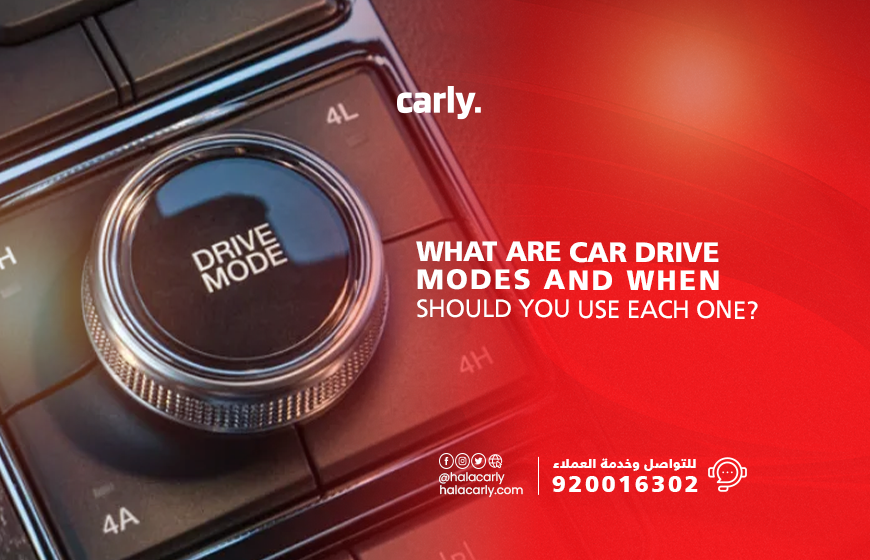
Driving modes in cars are systems that allow the driver to select a specific pattern to change the way the car responds. When an economical mode such as Eco is selected, the car handles acceleration more gently to reduce fuel consumption. When Sport mode is chosen, the car becomes more ready for a quick response and stronger acceleration.
These modes do not work the same way in every car. In some models their effect is limited to the throttle and gearbox, while in others they may extend to the steering, suspension system, drive system, and traction control. It is therefore important not to be satisfied merely with the name of the mode inside the car, but to understand its real benefit before making a purchase decision.

How Do Modern Driving Modes — or Drive Mode — Work in Cars?
Modern driving modes, or Drive Mode, rely on electronic systems inside the car that adjust certain settings as soon as the appropriate mode is selected from a button or dedicated menu. These adjustments may include throttle sensitivity, gear-change timing, steering weight, power distribution between the wheels, and the way the traction and stability control system intervenes — depending on each car’s equipment.
In simpler terms, the car does not turn into a completely different vehicle when the Drive Mode is changed, but it does alter the way it responds to the driver’s commands and road conditions. You may therefore feel that the same car becomes calmer and more economical when Eco mode is chosen, more lively and sharp when Sport is selected, and more capable of holding together on sand when Sand mode is used in a car equipped for that type of driving.
Understanding the Drive Mode system is therefore important before buying, because it helps you determine whether the car is suitable only for your daily use or whether it offers you greater flexibility on journeys and different types of roads.
The Most Common Drive Modes and When to Choose Each One
Modern driving modes give the driver greater ability to adapt the car’s performance to the nature of the road and the type of use. Each mode has a different function that affects the driving feel — whether in terms of response speed, smoothness of movement, fuel consumption, or the level of grip on sandy or slippery roads.
These modes should therefore not be used randomly; understanding them helps in choosing the most appropriate pattern for daily driving, travel, traffic jams, or trips off paved roads. Below are the most common driving modes in cars:
ابحث عن سيارة أحلامك الآن!
آلاف السيارات الجديدة والمستعملة بأفضل الأسعار. تصفح، قارن، واشتري بكل سهولة من خلال منصة كارلي الموثوقة.
Eco Mode — The Economy Mode
Eco mode is the economy mode of the car and aims to make driving calmer and less fuel-consuming. When activated, the car’s response to acceleration becomes less sharp and the gearbox may shift to higher gears earlier so that engine load is reduced.
This mode is very suitable for a customer who uses the car daily inside the city or on calm long trips and wants to reduce petrol expenses as much as possible, but it is not the best choice when acceleration is needed — such as overtaking, climbing inclines, or driving with a heavy load.
Normal Mode — The Balanced Mode
Normal mode is the balanced mode that suits most driving conditions. It does not focus solely on saving like Eco mode, nor does it deliver a sharp response like Sport, but instead provides natural performance that suits everyday use.
If you do not want to keep changing modes constantly, or if you use the car between the city and the motorway, Normal mode may be the most suitable most of the time. This mode is therefore important for the customer who wants a practical and easy-to-use car without complexity.

Comfort Mode
Comfort mode is designed for those seeking a smoother and calmer drive. In some cars it makes the steering lighter and the car’s response easier, and may affect the suspension system if the car is fitted with adaptive suspension.
This mode suits families, long-distance travel, and daily driving that prioritises comfort over performance. If you are searching on Carly for a family car or a car suitable for long journeys, the presence of Comfort mode may be a positive point worth noting.
Sport Mode — For Stronger Response
Sport mode makes the car more lively to drive. When activated, throttle response becomes faster and the gearbox may hold gears for longer to deliver stronger engine performance.
This mode is suitable for overtaking or driving on open and safe roads, but it is not the best choice for constant use inside the city as it may increase fuel consumption and make driving less calm. It is therefore best treated as an option for times when stronger performance is needed, rather than a fixed everyday mode.
Smart Mode
Smart mode suits the driver who does not want to think much about changing modes. This mode tries to read the driving style — if you are driving calmly it leans towards economical settings, and if your driving becomes more active it gives the car a stronger response.
This mode suits the customer who uses their car in different conditions throughout the day — such as city traffic followed by the motorway — because it provides a flexible experience without the need for constant manual intervention.
Snow Mode — For Low-Grip Roads
Snow mode is designed for roads with low grip. Although snow is not a common condition in Saudi Arabia, the idea behind this mode is to reduce the sharpness of acceleration and help the car move more stably when grip is poor.
This mode can be useful in some slippery conditions, but it does not prevent skidding completely and is no substitute for careful driving. It should therefore not be relied upon alone — attention must also be paid to tyre condition, speed, and safe following distance.
Sand Mode — For Off-Road Enthusiasts
Sand mode is one of the most important modes sought by many customers in Saudi Arabia, especially those who use four-wheel-drive vehicles or crossovers on desert trips. This mode helps the car handle sand by adjusting engine response and traction systems according to the car’s equipment.
If you are searching on Carly for a car suited to off-road use or sandy terrain, the presence of Sand mode may be an important feature — but you must also look at the type of drive system, ground clearance, engine power, and tyre condition, because Sand mode alone is not enough if the car is not suited to that type of use.
Mud Mode — For Unpaved Roads
Mud mode is designed for muddy roads or unpaved tracks that require higher traction. This mode generally appears in four-wheel-drive vehicles or cars designed for use away from ordinary roads.
This mode is not necessary for every customer — especially if the car is used only inside the city — but it may be important for those who drive in unpaved areas or need a car that can cope with road conditions harder than typical daily use.
Custom / Individual Mode
Some cars offer a Custom or Individual mode, which allows the driver to personalise certain settings according to their preferences. They may choose a more active engine response combined with comfortable steering, or calm driving with some sporty settings.
This mode suits the driver who knows what they prefer in a car and wants a personalised driving experience, but it is generally found in higher-specification categories. It is therefore better to review the car’s specifications carefully before buying.

Table Showing the Differences Between the Most Common Driving Modes
The following table summarises the most common driving modes in modern cars, clarifying the nature of each mode, the type of driver it suits, and the best time to use it. Nevertheless, the names of modes or the way they work may differ from one car to another depending on the manufacturer and the specifications of each model.
| Mode | Main Purpose | When to Use It? | Expected Effect |
| Eco | Reduce fuel consumption | Calm trips and daily commuting | Quieter response and lower consumption |
| Normal | General balance | Most everyday driving conditions | Natural performance without extremes |
| Comfort | Comfort and smoothness | Travel and family driving | Smoother and calmer drive |
| Sport | Stronger response and performance | Overtaking and open roads | Faster acceleration and higher consumption |
| Smart | Automatic selection based on driving | Mixed use | Adapts to the driver’s style |
| Snow | Reduce skidding | Slippery and low-grip roads | Calmer launch and better control |
| Sand | Driving on sand | Off-road and sandy areas | Better traction on sand |
| Mud | Mud and rough terrain | Unpaved tracks | Better control when grip is poor |
| Custom | Personalise settings | According to driver preference | Personal driving experience |
Do Driving Modes Affect Fuel Consumption?
Yes — driving modes may affect fuel consumption, especially when comparing Eco and Sport. The economy mode helps to calm the car’s performance, while Sport mode makes it more ready to accelerate, which may raise consumption.
However, it is important for the Carly customer to know that the driving mode is not the only factor. Engine condition, tyre pressure, vehicle weight, driving style, traffic, and air-conditioning use are all factors that affect consumption.
Therefore, when buying a used car, do not look only at the presence of Eco mode — also pay attention to the car’s condition and technical inspection before purchase.
Common Mistakes That Reduce the Benefit of Driving Modes
Although driving modes help the driver deal with different conditions, using them incorrectly may reduce their benefit or make the driving experience less efficient. Choosing the right mode should be linked to the nature of the road, the car’s condition, and the driver’s goal — not simply switching a mode on all the time. The most notable mistakes to be aware of are:
- Using Sport mode continuously inside the city, as it may increase fuel consumption and make driving sharper in traffic.
- Relying on Eco mode in all situations, especially when acceleration is needed or when climbing inclines.
- Activating Sand or Mud mode on paved roads, as these modes are designed specifically for sand, mud, and unpaved terrain.
- Believing that driving modes completely prevent skidding — they help improve control but do not eliminate the importance of careful driving.
- Ignoring tyre condition, because weak tyres or low tyre pressure reduce the effectiveness of any driving mode.
- Treating modes as a substitute for maintenance — these systems do not fix a problem in the engine, gearbox, or drive system.
- Choosing a car not suited to unpaved roads based on the mode name alone — the presence of Sand or Mud mode is not sufficient if the car is not genuinely appropriate for that type of terrain.

Examples of Cars on Carly That May Feature Drive Mode
You can also browse some examples of cars available through Carly to help you make a clearer decision and choose the car closest to your actual use — whether you are looking for an economical city car, a comfortable car for travel, or an option suited to trips and different types of roads.
| Car | Examples of Driving Modes | Who It Suits |
| Kia Seltos | Normal / Eco / Sport | Suits a customer looking for a small crossover for daily use with an economical or sporty option as needed. |
| Kia K5 2021 | Normal / Sport / Smart / Custom in some trims | A good example of a modern sedan that gives the driver flexibility between everyday driving and stronger response. |
| Kia Telluride 2021 | Eco / Sport / Comfort / Smart / Snow in some trims — may vary by drive system | Suitable when discussing large family cars, trips, and travel. |
| MG GT | Eco / Normal / Sport in some versions | A suitable example of a sporty sedan that combines daily use with a youthful, sporty character. |
Frequently Asked Questions
What Do Driving Modes in Cars Mean?
They are systems that allow the car’s response to be changed according to usage conditions — such as economical driving, sporty driving, comfort, or driving on sand and unpaved roads.
What Is the Difference Between Eco and Sport?
Eco mode focuses on reducing fuel consumption and calming the car’s response, while Sport mode delivers a faster response and stronger performance but may increase fuel consumption.
Is Eco Mode Always Suitable?
No — Eco mode is suitable for calm driving but is not the best option when quick overtaking is needed, when climbing inclines, or when driving with a heavy load.
Is Sand Mode Necessary in Saudi Arabia?
This mode is important if you drive on sand or go on desert trips, but it is not necessary for those who use the car exclusively inside the city.
Do All Modern Cars Feature Driving Modes?
No — equipment varies by brand and trim. Some cars offer only two modes while others provide multiple modes for comfort, sport, sand, and rough terrain.
Do Driving Modes Replace a Car Inspection?
No — driving modes are not a substitute for inspection. When buying a used car, the condition of the engine, gearbox, drive systems, and sensors must be verified, as these elements affect the car’s real performance.
Should Driving Modes Be a Key Factor in the Purchase Decision?
Yes — but they are not the only factor. Driving modes are important because they affect your feel for the car, but they should come as part of a comprehensive evaluation that includes price, technical condition, usage history, safety level, fuel consumption, parts availability, and maintenance costs.
Finally, driving modes in cars help you better understand a car’s character before buying. Not every economical car is suited to travel, not every car with Sport mode is suited to powerful performance, and not every car with Sand mode is genuinely equipped for desert trips. When choosing your next car from Carly, try to link the driving modes to your real needs, compare the available cars, review the specifications, pay attention to the car’s condition, and make use of pre-purchase inspection services — so that you reach a car that suits your daily routine, your budget, and the nature of the roads you drive on.