Saudi Arabia Car Market 2024: Sales Statistics, Brand Rankings, and Industry Trends
Saudi Arabia’s new light vehicle market hit its highest level in 8 years in 2024, with sales growing 7.8% year-on-year and extending a five-consecutive-year growth streak. Toyota maintained its dominant position with 5 models in the national top 10, but the standout performances belonged to Suzuki (up 46.6%) and MG (up 65.9%). The electric vehicle segment exploded with a 757.2% surge, led by Lucid. This article provides a complete statistical breakdown of Saudi Arabia’s 2024 automotive market including brand rankings, model performance, EV trends, and the economic factors shaping the industry.
Table of Contents
- 2024 market overview: the headline numbers
- Brand-by-brand rankings and growth rates
- Top-selling car models in Saudi Arabia 2024
- The electric vehicle surge
- Economic factors driving the market
- Medium-term market trajectory
- What the data means for car buyers
- FAQ
2024 Market Overview: The Headline Numbers
The Saudi Arabian vehicle market recorded its 5th consecutive year of growth in 2024, with new light vehicle sales increasing 7.8% compared to 2023. This marks the best annual performance in 8 years, confirming that the post-pandemic recovery has not only held but accelerated.
To put this in context, sales in 2023 totaled 729,466 units (growing 16.9% from the prior year). The 7.8% growth in 2024 means the market is now firmly above 780,000 units annually, approaching levels not seen since the pre-austerity period.
The growth is broad-based. It is not driven by a single brand or segment. Korean manufacturers gained significant ground, Chinese brands consolidated their position in the budget segment, and the EV market went from niche experiment to genuine momentum. Saudi Arabia currently ranks as the 22nd largest vehicle market globally, though it remains below the all-time record set in 2015 during a period of high oil prices and rapid consumer credit expansion.
Brand-by-Brand Rankings and Growth Rates
Here is how every top-10 brand performed in 2024 compared to the prior year.
1. Toyota maintained its commanding lead with a modest 2% increase in volume. Toyota’s dominance in Saudi Arabia is structural, not cyclical. The brand holds the top spot in sedans (Yaris, Camry), SUVs (Land Cruiser, Fortuner, RAV4), and commercial vehicles (Hilux). With 5 models in the national top 10, Toyota’s market position remains virtually unassailable. The brand’s strength lies in extreme reliability in Saudi Arabia’s climate, the broadest dealer network in the Kingdom, and resale values that consistently outperform every competitor.

2. Hyundai held second place with 6.7% year-on-year growth. The Accent’s strong performance (up 27.3%) drove much of this gain, along with steady demand for the Tucson and Elantra. Hyundai’s combination of competitive pricing, generous warranty terms, and an expanding Saudi dealer network continues to close the gap with Toyota in several segments.
3. Kia was the biggest gainer among established brands, surging 26.6%. The Sportage and K3 were key contributors. Kia has successfully repositioned itself from a budget brand to a value-premium offering, with design quality and feature content that now matches or exceeds European competitors at a fraction of the price.

4. Nissan was essentially flat at -0.1%, maintaining its position through the continued popularity of the Sunny, Patrol, and X-Trail but showing no real growth momentum.
5. Ford grew 16.4%, driven by strong demand for the Expedition and the continued relevance of the Explorer in the mid-size SUV segment.
6. Suzuki jumped 4 spots in the rankings with a remarkable 46.6% increase. The Ciaz and Swift have found a receptive audience among budget-conscious buyers who want Japanese reliability without Toyota or Nissan pricing. Suzuki’s value proposition is compelling: proven engineering at aggressive price points.
7. Changan dropped one spot despite remaining in the top 10, with volume declining 7.8%. This is notable because Changan was one of the fastest-growing brands in previous years. The decline suggests increasing competition from other Chinese manufacturers and potentially some market saturation in the ultra-budget segment.
8. Geely fell 2.6% but held its 8th place ranking. The Coolray crossover remains its volume driver, but the brand faces mounting competition from MG and Chery.
9. Mazda grew 3.8%, a modest but steady gain for a brand that competes on driving dynamics and design rather than aggressive pricing.
10. MG closed the top 10 with the most explosive growth of any established brand at 65.9%. MG’s combination of Chinese manufacturing costs, British brand heritage, and feature-rich specifications at aggressive prices has resonated strongly with Saudi buyers, particularly in the compact SUV and sedan segments.


Top-Selling Car Models in Saudi Arabia 2024
At the model level, the data reveals which specific vehicles Saudi buyers are choosing most.
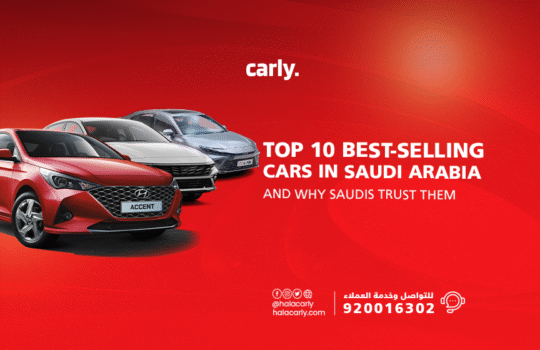
The Toyota Yaris Sedan claimed the top spot as the best-selling car in Saudi Arabia, with sales up 7.8% year-on-year. The Yaris has held this position consistently because it hits the exact center of what Saudi buyers want in a daily driver: Toyota reliability, low fuel consumption, accessible pricing, and strong resale value. On Carly, the Yaris is one of the most popular models in both new and used inventory.
The Hyundai Accent climbed one spot to second place with an impressive 27.3% increase. The Accent serves a similar market to the Yaris but at a lower price point, making it the go-to choice for budget buyers who want a Korean alternative with strong warranty backing.
Toyota placed 5 models in the national top 10, a concentration of market power that no other manufacturer comes close to matching. This included the Camry, Hilux, Land Cruiser, and Fortuner alongside the Yaris, covering every major vehicle category from economy sedan to full-size off-road SUV.
The Electric Vehicle Surge
The most dramatic number in the 2024 data is the 757.2% growth in electric vehicle sales. While the EV segment remains small in absolute terms compared to the overall market, this growth rate signals a structural shift that will reshape the Saudi automotive landscape in coming years.
Lucid claimed the top EV brand position, jumping 14 places in the rankings. This is significant because Lucid is building a manufacturing facility in Saudi Arabia as part of the Public Investment Fund’s strategy, positioning the Kingdom as both a consumer and producer of premium EVs.
Hyundai ranked second in EV sales, reflecting the global success of the Ioniq lineup. Lexus placed third, capitalizing on its electrified models. MG, Mercedes, and Genesis also registered strong EV gains.
The growth is fueled by government policy (Saudi Arabia has committed to a net-zero emissions goal by 2060 under Vision 2030), expanding charging infrastructure from both public and private sector investment, and falling EV prices as global production scales.
For Saudi car buyers, the EV surge means more options and more competitive pricing in coming years. On Carly, the platform continues to expand its inventory across all powertrains as the market evolves.
Economic Factors Driving the Market
The 2024 vehicle market growth did not happen in a vacuum. Several macroeconomic factors created favorable conditions.
Non-oil GDP growth of 3.5% signals that Saudi Arabia’s economic diversification is producing real results. More economic activity means more jobs, more consumer spending, and more demand for vehicles. The IMF’s assessment confirms that the Kingdom’s non-oil economy is expanding robustly even as oil production was cut.
Employment expansion: Over one million jobs were added in 2023, bringing unemployment down to 7.7%. More people working means more people needing cars, particularly in a country where distances and climate make vehicle ownership essential.
Low inflation at 1.6% (by April 2024) means consumer purchasing power has been preserved. Vehicle prices have not increased as rapidly as in some other markets, making car ownership relatively more affordable.
Tourism revenue surge has added a new demand driver. More tourism means more rental fleets, more hospitality sector employment, and more economic activity in cities like Riyadh, Jeddah, and NEOM.
On the less favorable side, the current account surplus fell to 3.2% of GDP as oil exports declined, and the fiscal deficit widened to 3% of GDP. However, external reserves covering 13 months of imports ensure financial stability, and oil output is projected to rebound in 2025, driving overall GDP growth to 4.5%.
Saudi Arabia’s 17th global ranking in competitiveness and record foreign investment inflows confirm that the market fundamentals remain strong for continued automotive growth.
Medium-Term Market Trajectory
Looking at the historical arc, Saudi Arabia’s vehicle market tells a story of boom, correction, and recovery.
The market hit its all-time record in 2015 following a fast-growing decade fueled by high oil prices and consumer credit expansion. But the rapid growth was followed by years of difficulty correlated with the oil price collapse that limited GDP growth. Then the 2020 pandemic measures further hit the industry, with sales falling to approximately 469,000 units.
The recovery since 2020 has been strong and consistent. Sales rebounded 24.6% in 2021, grew further in 2022, surged 16.9% in 2023 to 729,466 units, and added another 7.8% in 2024. Five consecutive years of growth have brought the market back toward its historical peak.
The medium-term outlook is moderately positive. GDP expansion driven by Vision 2030 projects, population growth, and opportunities to increase the circulating vehicle fleet all support continued demand. The EV transition adds a replacement cycle dynamic that could boost sales above the natural population-driven growth rate.
For car buyers, this market trajectory means growing inventory selection, increasing competition between brands (which pressures prices down), and more financing options as banks compete for a larger auto loan market. On Carly, this translates to more choices, competitive prices, and access to financing from 12+ institutions.
What the Data Means for Car Buyers
The 2024 market statistics contain practical signals for anyone buying a car in Saudi Arabia.
Toyota remains the safest resale bet. With continued market leadership and 5 models in the top 10, Toyota vehicles will hold their value better than any alternative. If resale matters to you, Toyota is still the mathematically correct choice.
Korean brands are the best value-for-money. Hyundai’s 6.7% growth and Kia’s 26.6% surge reflect genuine consumer recognition that Korean cars now offer premium quality at non-premium prices. The Hyundai Tucson and Kia Sportage are among the most competitive vehicles in the Saudi market.
Chinese brands are here to stay. Despite Changan’s dip, the category is growing. MG’s 65.9% explosion proves that Chinese manufacturing can deliver vehicles that Saudi buyers actively choose, not just tolerate. Chinese cars represent the strongest value in the budget segment.
The EV transition is accelerating faster than predicted. A 757.2% growth rate is not incremental. Buyers planning their next purchase should at least evaluate EV and hybrid options, especially as charging infrastructure expands.
Competition is increasing, which benefits buyers. More brands growing means more competition, which means better pricing, better financing terms, and better after-sale service as manufacturers fight for market share.
On Carly, buyers can access all of these brands in one place with 150-point inspection, 12-month warranty, Tamara zero-interest installments on cars under 50K, and Amwal credit card financing for any price range.
FAQ
How much did the Saudi car market grow in 2024?
New light vehicle sales in Saudi Arabia grew 7.8% year-on-year in 2024, marking the highest market level in 8 years and the 5th consecutive year of growth.
What is the best-selling car in Saudi Arabia?
The Toyota Yaris Sedan was the best-selling car in Saudi Arabia in 2024, with sales growing 7.8% year-on-year. The Hyundai Accent ranked second with a 27.3% increase.
Which car brand grew the fastest in Saudi Arabia in 2024?
MG recorded the highest growth among top-10 brands at 65.9%. Suzuki was second with 46.6% growth, and Kia third with 26.6%.
How big is the Saudi Arabia car market globally?
Saudi Arabia is the 22nd largest vehicle market in the world, though it remains below its all-time record volume set in 2015.
How fast are EVs growing in Saudi Arabia?
The EV segment in Saudi Arabia grew 757.2% in 2024, with Lucid, Hyundai, and Lexus leading the category. The growth is driven by government policy, infrastructure expansion, and falling global EV prices.
What are the top 10 car brands in Saudi Arabia?
In order for 2024: Toyota, Hyundai, Kia, Nissan, Ford, Suzuki, Changan, Geely, Mazda, and MG. Toyota dominates with 5 models in the national top 10.
Is now a good time to buy a car in Saudi Arabia?
Growing competition between brands is pushing prices and financing terms in favor of buyers. Platforms like Carly offer access to 30+ brands with inspection, warranty, and multiple financing options in one place.