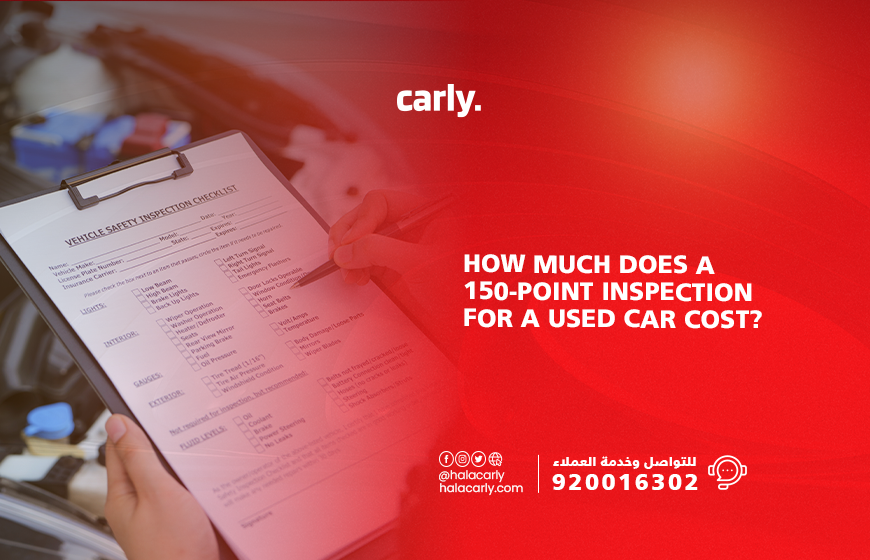
Before you spend a single riyal on a used car, one question separates a winning deal from a financial disaster: was this car genuinely inspected — or just given a quick once-over?
The Saudi used-car market is growing fast, but it is plagued by a culture of concealment: odometer tampering, hidden accident histories, and original parts swapped out for cheap imitations. The 150-point inspection is the industry-accepted system that exposes these hidden faults before you sign anything.
In this Carly guide you will find: real market prices in Saudi Arabia, everything a 150-point inspection covers, the difference between inspection types, and how choosing the right platform saves you both time and money.
How Much Does a 150-Point Used Car Inspection Cost in Saudi Arabia?
The cost varies depending on the vehicle type, the inspection centre, and the depth of the check. The table below gives you an honest, up-to-date picture of current market prices:
| Notes | Price (SAR) | Inspection Type | Vehicle Type |
| Official periodic technical inspection | SAR 115 incl. VAT | Periodic (MVPI) | Private / small cars |
| Pre-purchase comprehensive check | SAR 99 – 149 | Basic used-car inspection | Small cars |
| Market standard for sedans | SAR 150 – 250 | Full 150-point inspection | Family cars / SUVs |
| 4WD & off-road vehicles | SAR 199 – 299 | Advanced comprehensive inspection | SUVs / 4WD |
| Premium & luxury segment | SAR 299 – 599 | Luxury / full digital inspection | Luxury cars |
| Included FREE with every Carly purchase | FREE with purchase | 150-point inspection + digital report | All cars on Carly |
What Does a 150-Point Used Car Inspection Cover?
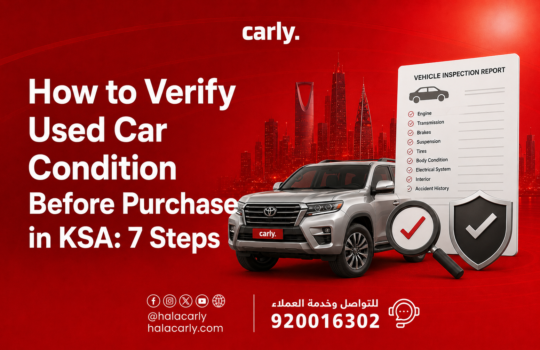
A 150-point inspection is not a casual walk-around — it is a methodical check across six core categories:
| No. of Points | Inspection Areas | Category |
| 30+ points | Engine, gearbox, fluids, performance | Mechanical |
| 25+ points | Lights, battery, sensors, ECU diagnostics | Electrical |
| 20+ points | Tyres, brakes, suspension, steering | Safety |
| 20+ points | Body, paintwork, accident history detection | Exterior Body |
| 25+ points | Seats, AC, screens, accessories | Interior |
| 30+ points | Live road test, engine sound, throttle response | Road Test |
1. Engine & Gearbox — The Heart of the Car
The specialist inspector starts the engine and analyses its sound and performance. This covers:
• Engine compression and detection of any internal or external leaks
• Engine oil level, colour, and contamination level
• Gearbox smoothness, engagement quality, and absence of vibrations
• Signs of prior engine opening or undisclosed repair work
• Air filter, fuel filter, and drive belts
• Cooling system, radiator, and head gasket seals
ابحث عن سيارة أحلامك الآن!
آلاف السيارات الجديدة والمستعملة بأفضل الأسعار. تصفح، قارن، واشتري بكل سهولة من خلال منصة كارلي الموثوقة.
2. Body & Paintwork — Revealing Hidden Accidents
This category exposes more than any other whether the car has been in a previous accident. It includes:
• Electronic paint-thickness gauge to detect re-sprayed panels
• Checking the uniformity of gaps between doors, bonnet, and boot
• Detecting weld marks or panel straightening on the chassis
• Inspecting the engine bay for signs of structural deformation
• Undercarriage and chassis inspection from below
3. Brakes, Tyres & Suspension — Safety First
The most critical checks from a road-safety perspective:
• Brake pad thickness and condition of front and rear brake discs
• ABS system and brake sensors
• Tyre age, tread depth, and uneven wear patterns
• Suspension system and sounds over speed bumps
• Wheel hubs, knuckles, and wheel nuts
4. Electrical Systems
With modern vehicles increasingly complex, the electrical check is more important than ever:
• Battery charge level and health
• OBD2 computer scan to reveal hidden fault codes
• Air conditioning effectiveness — cooling and heating
• All front, rear, and side lights
• Infotainment screen, rear camera, and parking sensors
• Airbags and seatbelt system
5. Interior
A thorough assessment of the cabin condition:
• Seat condition — cracks, stains, and odours
• All electrical buttons and switches
• Roof lining for signs of water leaks
• Boot space and spare tyre
• Cross-referencing chassis numbers against official documents
6. Road Test — The Real Exam
No inspection is complete without an actual test drive:
• Vehicle behaviour under acceleration and braking
• Engine sound under load
• Brake response in real traffic conditions
• Pulling or drifting when hands are released from the wheel
• Abnormal vibrations through the steering wheel
Periodic Inspection vs. Used Car Pre-Purchase Inspection — What Is the Difference?
Many buyers confuse two fundamentally different types of inspection:
Periodic Technical Inspection (MVPI)
This is a mandatory government inspection overseen by the Saudi Standards, Metrology and Quality Organization (SASO). Its purpose is to verify that a vehicle is roadworthy. Official 2025 fees:
• Private / small cars: SAR 115 including VAT
• Re-inspection after failure: SAR 37 including VAT
• Covers: brakes, lighting, exhaust emissions, basic safety
This inspection confirms the car poses no immediate danger on public roads — but it does not reveal the car’s history or assess its full commercial condition.

150-Point Pre-Purchase Inspection
This is a detailed inspection designed to protect the buyer. It reveals the car’s true condition beyond what the law requires:
• Uncovers accidents that were concealed with a fresh coat of paint
• Detects odometer tampering
• Produces a written report you can use as a negotiation tool
• Identifies expected future maintenance costs
• Empowers the buyer to make a fully informed decision
How to Choose a Used Car Inspection Centre in Saudi Arabia
Not everyone who claims to inspect cars actually does so properly. Here are the criteria that matter:
1. Digital Documentation
A good centre gives you a photo-supported digital report — not a handwritten note. The report must include images and fault codes for every issue found.
2. Use of Diagnostic Equipment
Never accept an inspection without a paint-thickness gauge and an OBD2 scanner. A visual check alone is insufficient.
3. Actual Road Test
Any centre that does not start and drive the car is not offering a real inspection.
4. Accreditation & Reviews
Read Google reviews and speak to past customers. Reputable companies in the Saudi market have a transparent track record.
5. Inspection Guarantee
Some providers offer a 30-day guarantee on their inspection report — a strong signal of confidence in the quality of their service.
The 150-Point Inspection at Carly — Built Into Every Purchase
Carly (halacarly.com) is Saudi Arabia’s certified used-car platform, headquartered in Riyadh. Carly operates on a different principle: why should you pay twice — once for an inspection and once for the car — when the inspection should be a guaranteed right, not an add-on?
What Sets Carly’s Inspection Apart?
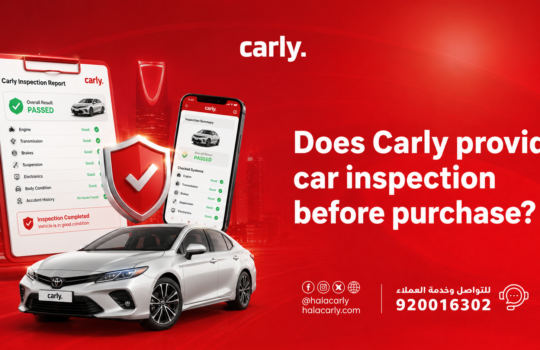
• Over 150 primary and secondary inspection points on every car before it is listed
• Transparent digital report available to the buyer before the deal is finalised
• Engine, gearbox, body, electrical, and suspension issues all covered
• 12-month warranty on the car after purchase
• 7-day return right if any undisclosed problem is discovered
• Easy financing through 12 accredited financing partners
A Carly buyer does not pay SAR 150–299 on an external inspection and then find that the report doesn’t obligate the seller to anything. At Carly, the report is part of the warranty contract.

8 Red Flags That Should Make You Walk Away — or Demand a Major Discount
Even with a seller’s assurances or a preliminary report, certain warning signs tell you this car may be a financial trap. If you notice any of the following, you have two options: walk away immediately, or insist on a deeper inspection to quantify the true cost of repair:
1. Mismatched Paint Shade or Uneven Panel Gaps
If you notice a slight difference in gloss or colour between doors and wings, or find that the gaps between body panels are inconsistent, this is conclusive evidence that the car has been in a significant accident and repaired with cheap aftermarket parts or amateur bodywork.
2. Cabin Wear That Does Not Match the Odometer Reading
Does the odometer claim 60,000 km while the steering wheel, driver’s seat, and pedals are visibly worn and deteriorated? This visual contradiction is the primary indicator of odometer tampering — and a 150-point inspection will read the true figure directly from the car’s ECU.
3. Seller Refusing an Independent Inspection
If the seller insists on inspecting the car at a centre of his choosing, shows discomfort when you request a neutral 150-point inspection centre, or refuses to connect an OBD2 scanner — walk away immediately. There are hidden disasters he does not want you to find.
4. Programmatically Cleared Fault Codes
Some fraudsters clear the Check Engine light hours before listing the car for sale so the dashboard appears clean. An advanced scan will reveal the historical record of hidden fault codes waiting to reappear the moment the car is yours.
5. White Residue in Engine Oil
When you open the engine oil cap, if you find a creamy, coffee-and-milk-like substance, this means coolant has mixed with the engine oil. This defect — a blown head gasket — is extremely expensive to repair and often means the entire engine needs replacing.
6. Rust or Corrosion on the Undercarriage
Light surface rust on the exhaust system can be normal. But deep rust and corrosion on the chassis or at the base of doors typically indicates the car was flooded, which predicts a cascade of electrical failures over time.
7. Clicking or Rattling From the Suspension
When test-driving the car over speed bumps or around corners, if you hear metallic grinding or obvious clicking noises, this points to worn suspension components — shock absorbers, control arms, or ball joints. These are costly to replace and directly affect your safety and road stability.
Frequently Asked Questions
Can the inspection be done at the seller’s location or at my place?
Yes. Some specialist centres in Saudi Arabia offer a mobile inspection service at the seller’s location — a practical option if you don’t want to drive the car before verifying it. The cost may be SAR 30–50 higher than a workshop visit.
Is the inspection report legally binding on the seller?
In the open market (private sale), no. But when buying from a certified dealership or specialist platform like Carly, the report becomes part of the warranty contract and is legally binding.
How long does a full inspection take?
Between 30 minutes for a quick check and up to two hours for a full inspection that includes a road test, computer scan, and structural assessment.
Is it worth paying SAR 200–300 for an inspection?
Absolutely. The cost of repairing an engine or gearbox in Saudi Arabia starts at SAR 3,000 and can reach tens of thousands. Spending SAR 200 to avoid that surprise is a sound financial decision.
What is the difference between a 150-point and a 200-point inspection?
150 points is the agreed industry standard for a comprehensive inspection. Some platforms advertise 200 or more points by subdividing primary checkpoints into finer sub-items. What matters is the thoroughness of the inspection, not the number.
The Bottom Line — The Smart Buyer’s Rule
A 150-point used car inspection is an investment, not an added cost. In the used-car market, the price of ignorance is far higher than the price of due diligence.
If you are buying from a private seller or an open market, never waive the inspection — even if it costs SAR 250. If you choose to buy through Carly, the inspection is guaranteed, the report is transparent, and the warranty is 12 months — no extra payment required.