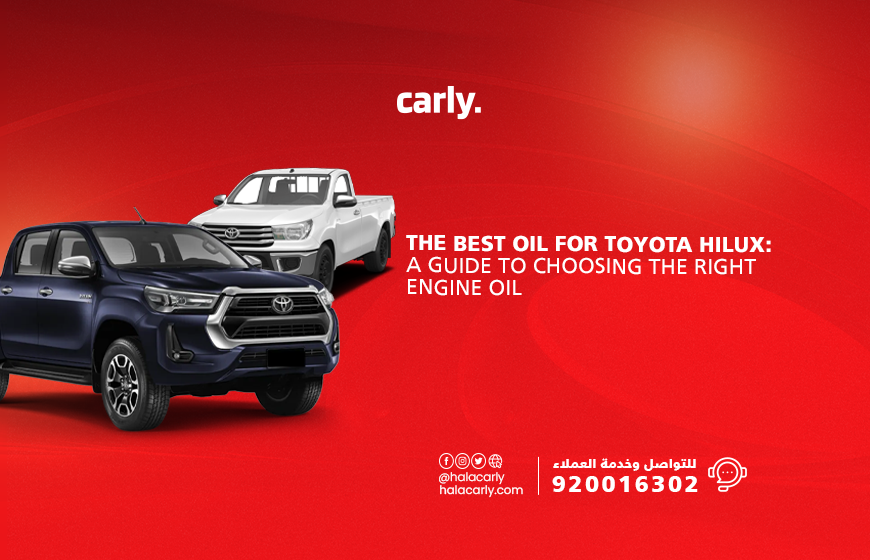
The Toyota Hilux in Saudi Arabia is known as one of the most practical vehicles, and its owners always pay close attention to every detail and everything that maintains engine power and efficiency in the long term. One of the most important elements of car care is choosing the right engine oil, as it helps reduce friction, cool internal components, clean the engine from impurities, and support performance during driving and its various conditions. When searching for the best oil for Toyota Hilux, you should not limit yourself to a well-known brand name or rely on other people’s experiences, because the right oil differs according to engine type, model year, and usage nature. The hot Saudi climate, frequent long-distance driving, and the occasional heavy-duty use of the Hilux all make oil selection an important and impactful decision that directly affects engine life and performance.
In this article, the Carly website helps its customers understand how to choose the right oil for the Toyota Hilux, Toyota Hilux, covering the most common viscosity grades, the difference between petrol and diesel oil, the most important mistakes to avoid to protect the engine, and when oil should be changed.
Why Is Choosing the Best Oil for Toyota Hilux Important?
Choosing the best oil for Toyota Hilux is important because it plays a fundamental role in protecting the Hilux engine from wear caused by the continuous movement of internal metal parts. When the oil viscosity is appropriate and its quality is good, it helps form a protective layer that reduces friction, maintains performance stability, and alleviates the stress the engine is subjected to in high heat or during driving, especially on long distances during travel or trips.
Using unsuitable oil may over time lead to weak lubrication, engine overheating, internal deposits, and reduced smoothness of driving. For this reason, choosing oil is not just a simple routine step — it is an important part of preventive maintenance that preserves the vehicle’s efficiency and reduces the likelihood of costly breakdowns in the future.

What Is Meant by the Best Oil for Toyota Hilux
What is meant by the need for the best oil for Toyota Hilux is not the preference for a specific product that suits all vehicles, but rather the oil that matches the engine specifications and works efficiently in actual usage conditions. Some Hilux categories run petrol engines while others run diesel, and recommendations also vary from model to model. Therefore, one type cannot be generalized to all vehicles. The best oil here is determined by a set of factors, the most important being that the oil is compatible with the engine type, and that the correct viscosity is selected, that the oil quality meets the specifications, that it is suitable for driving conditions in Saudi Arabia according to road types and weather conditions, and that it adheres to what the owner’s manual recommends. The more these factors are present in the oil, the more it is considered the best oil for Toyota Hilux.
Best Oil for Toyota Hilux Petrol Engines
In petrol Toyota Hilux vehicles, the owner is usually looking for an oil that gives the engine a good balance between protection, flow, and heat resistance. In many cases, the grade 10W-30 10W-30 is one of the most common grades among users due to its suitability for a large number of daily uses and its ability to deliver balanced performance in relatively hot climates.
The importance of the right oil for petrol engines is evident in that it helps achieve smooth operation, reduces wear of internal components, and maintains performance stability with repeated use.
However, despite the prevalence of some grades, the final judgment must always remain tied to the manufacturer’s recommendation, as some models may need a different viscosity depending on engine design and year of manufacture.
Best Oil for Toyota Hilux Diesel Engines
Diesel engines in the Toyota Hilux are generally associated with heavy use, whether in transport, work, or long-distance driving. They therefore need an oil that withstands pressure and provides stable engine protection. Here grades such as 15W-40 and5W-30 appear among the options that users look for, but the choice between them is not made randomly but rather based on the vehicle’s own specifications.
The right oil for a diesel engine must be capable of resisting thermal stress and maintaining lubrication quality under harsh operating conditions while helping reduce the accumulation of deposits from prolonged use. Therefore, the best oil for the Hilux diesel is the oil that combines the correct viscosity with the appropriate specification — not simply the most widely used oil among drivers.
ابحث عن سيارة أحلامك الآن!
آلاف السيارات الجديدة والمستعملة بأفضل الأسعار. تصفح، قارن، واشتري بكل سهولة من خلال منصة كارلي الموثوقة.
The Difference Between 5W-30 and10W-30 and15WW-40 for the Hilux
Choosing the appropriate oil viscosity is one of the most important steps that affects the efficiency and lifespan of the Toyota Hilux engine. Each viscosity grade provides a different level of flow, protection, and durability, so it is not enough to just look at the number — you must understand what each grade provides to the engine under different operating conditions.
| Viscosity Grade | Definition | Key Advantages | Important Notes |
| 5W-30 | A low-viscosity oil that flows quickly at startup, helping lubrication reach engine parts faster. | Excellent flow at startup, good support for performance efficiency, reduced friction at engine start | Suitable for some engines requiring lighter oil; only used if vehicle specifications allow it |
| 10W-30 | A balanced oil that combines good flow with an adequate protection level; considered one of the most practical grades for regular use. | Good balance between protection and smoothness, stable performance, suitable for daily driving and moderate conditions | One of the grades preferred by many owners when it matches the manufacturer’s recommendation |
| 15W-40 | A relatively higher density oil, used when greater durability and stability are needed under harsh operating conditions. | Strong engine protection, good pressure tolerance, suitable for heavy-duty use and high loads | Generally viewed as a practical option for some diesel engines or heavy operating conditions, provided it matches the manual’s recommendation |
This table shows the key differences between grades 5W-30 and10W-30 and15W-40 in terms of performance nature and protection, but it does not mean that there is one single grade that is best for all Toyota Hilux vehicles.
Choosing the best oil for Toyota Hilux must always depend on the engine type, model year, usage conditions, and what the owner’s manual recommends..
Which Is Better for Toyota Hilux: Full Synthetic or Semi-Synthetic Oil?
This question is important because many Hilux owners balance performance and cost when choosing oil.
- Full Synthetic Oil: it typically offers better heat resistance and maintains its properties for a longer period while reducing deposits inside the engine. Therefore it is suitable for those who use the car intensively or in harsh operating conditions.
- Semi-Synthetic Oil: it provides a practical solution for those who want good performance at a lower cost and is suitable for moderate use if the viscosity and specification are correct.
Therefore it can be said that the choice between full synthetic and semi-synthetic oil does not depend on absolute preference but is determined by the usage style of the Toyota Hilux, the degree of engine stress, and the budget allocated for periodic maintenance.

When Should Toyota Hilux Oil Be Changed?
Changing oil at the right time is an essential part of maintaining engine health, as oil gradually loses some of its efficiency over time, especially if the car is used frequently or in harsh conditions. Delaying an oil change may also lead to a decline in lubrication quality and an increase in impurities inside the engine, which affects performance and the lifespan of internal parts.
There is no single schedule that applies to all Toyota Hilux vehicles in all conditions, as the need for an oil change is affected by the type of oil used, the nature of driving, and the extent of the vehicle’s exposure to loads or long travel. Therefore, regular monitoring and adhering to the maintenance schedule remain among the most important factors in preserving the engine and not treating oil as an element that can be postponed without consequence.
This is where the importance of specialized platforms like Carly becomes clear, which offer an integrated experience that is not limited to buying and selling cars but also includes periodic technical inspection services that help better understand the vehicle’s condition and make maintenance decisions at the right time.
Signs Indicating That the Hilux Oil Needs Changing
There are some signs that may alert the driver that the engine oil is no longer performing its function at the required efficiency and that it needs inspection or replacement. Paying attention to these indicators early helps protect the engine. Below are the most important signs:
- Noticeable roughness in engine sound: this indicator may mean that the oil is no longer reducing friction between internal parts with the required efficiency, especially during startup or acceleration.
- Relative weakness in pull or performance: when oil loses its efficiency, you may feel that the car has become heavier in response and less lively while driving.
- Unusual engine overheating: deterioration in oil quality may increase friction inside the engine, causing its temperature to rise noticeably.
- Severe change in oil color: turning very dark or having a dirty appearance indicates the accumulation of impurities and loss of some of its properties.
- Burning smell: may be a sign that the oil has been exposed to high heat or that its change has been delayed longer than necessary.
- Noticeable increase in fuel consumption: old or unsuitable oil may cause the engine to work harder, which is reflected in fuel consumption.
Is Oil from the Authorized Dealer Better Than Other Commercial Oils?
Some Toyota Hilux owners prefer to use oil from the authorized dealer because it gives them a higher level of confidence in terms of suitability and specification, as it is usually linked to official maintenance service and reduces the chances of choosing unsuitable engine oil. However, this does not necessarily mean that other commercial oils are of lower quality, as there are reliable options that offer excellent performance when they are genuine, from a well-known brand, and matching the recommended viscosity and specification. Therefore, true preference remains tied to the quality of the oil and its compatibility with the vehicle — not just the name of the provider.
Here the importance of regular monitoring of the vehicle’s condition becomes clear, because choosing the right oil cannot be separated from understanding the technical state of the engine and its actual needs — which is what makes services such as Carly’s periodic technical inspection more useful for car owners who want to maintain performance and detect any indicators that need early attention.

Common Mistakes When Choosing the Best Oil for Toyota Hilux
Some Toyota Hilux owners make mistakes when choosing engine oil. These mistakes may seem minor at first but gradually affect engine efficiency and lifespan. They often result from haste or reliance on inaccurate general information. Below are the common mistakes:
- Choosing oil based on another person’s experience without comparing both vehicles’ specifications — the oil may be suitable for another car but not for yours due to differences in engine, model, or other specifications.
- Using a viscosity that does not match the manufacturer’s recommendation, which may affect oil flow speed and lubrication efficiency inside the engine.
- Believing that the best oil for Toyota Hilux is the heaviest — not every heavy oil means better protection, because each engine has its own appropriate viscosity.
- Buying oil from an unreliable source, which may expose you to a counterfeit or low-quality product.
- Delaying oil changes for extended periods, which results in the gradual loss of its efficiency with heat and use, and the accumulation of impurities within.
- Neglecting to change the oil filter with the maintenance — it is an important part as it prevents impurities from reaching internal engine parts. Leaving it unchanged may reduce the benefit of the new oil and weaken lubrication efficiency.
- Switching between multiple types randomly without a clear reason — changing oil randomly makes it harder to track vehicle performance and leads to inaccurate decisions. The best approach is to stick to a suitable and consistent oil as long as it achieves the required performance.
Carly’s Tips for Maintaining the Toyota Hilux Engine
Caring for the Toyota Hilux engine does not stop at choosing the right oil alone — it also includes some simple habits that help maintain engine efficiency and reduce the likelihood of breakdowns over time. Below are the most important tips that Carly offers for maintaining the Toyota Hilux engine:
- Oil level must be checked periodically. Monitoring the oil level helps detect any shortage early before it affects the engine.
- Use a good oil filter with every change, as a good filter contributes to purifying the oil and preventing impurities from reaching engine parts.
- Do not delay periodic maintenance with Carly, and adhere to schedules that maintain engine performance stability and reduce the chances of sudden problems arising.
- Choose oil from a guaranteed source, as buying oil from a trusted provider reduces the chances of obtaining a counterfeit or low-quality product, ensuring the engine better protection and more stable performance.
- Do not stress the engine immediately after startup — give it time until the oil begins circulating properly.
- Monitor any change in car sound or performance, as any roughness or weakness in pull may be an early indication that the car needs inspection.
- Stick to one appropriate viscosity unless there is a technical reason to change, to make it easier to track vehicle performance and make maintenance results clearer.
Frequently Asked Questions
What Is the BestOil for Toyota Hilux?
The best oil is the one that matches the manufacturer’s recommendation in terms of viscosity and specification, taking into account engine type and usage conditions.
Is 10WW-30 Suitable for Toyota Hilux?
It may be suitable for many Hilux petrol categories but the owner’s manual must always be checked before relying on it.
Is 15WW-40 Suitable for Hilux Diesel?
It may be suitable for some Hilux diesel vehicles, especially under heavy use conditions, provided it matches the vehicle’s specifications.
Which Is Better: Full Synthetic or Semi-Synthetic Oil?
Full synthetic oil provides higher protection and better stability in harsh conditions, while semi-synthetic is a good economical option for moderate use.
When Should Toyota Hilux Oil Be Changed?
This depends on the type of oil, the nature of vehicle use, and the maintenance schedule, but the important thing is not to delay the change and to periodically monitor the oil condition.
In conclusion, we can say that choosing the best oil for Toyota Hilux is not merely a popular choice among drivers but is the decision that brings together the correct specification, the appropriate viscosity, and an understanding of the vehicle’s condition. True care for the engine does not begin only with an oil change but starts from awareness of usage nature and regular monitoring. This is where the Carly website and app stand out as a specialized platform that not only brings together car buying and selling but also provides a periodic technical inspection service that helps users monitor their vehicle’s condition more clearly and make sound decisions regarding maintenance and performance preservation.