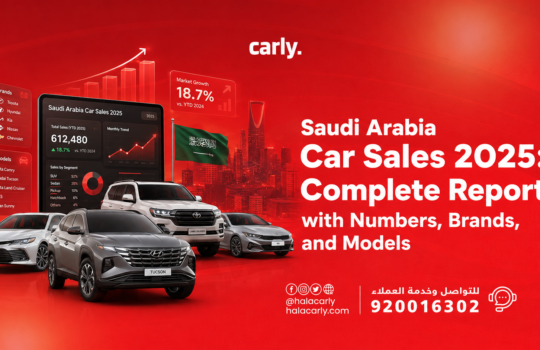
Car sales in Saudi Arabia during the first half of 2026 reached around 410,000 vehicles, confirming the Kingdom’s position as the largest car market in the Gulf. Car sales in Saudi Arabia revealed continued Japanese dominance led by Toyota, and a striking Chinese rise that placed four brands in the top ten. Moreover, the data showed a gradual shift in buyer preferences. Below is the complete statistical analysis of car sales in Saudi Arabia for H1 2026, with numbers, market shares, and brands, after verifying the sources.
Quick summary: Saudi Arabia recorded around 410,000 vehicles sold in H1 2026. Toyota led with 126,300 vehicles (30.8% market share), followed by Hyundai (53,300) and Kia (34,400). The highlight: four Chinese brands (MG, Haval, Jetour, and Changan) entered the top ten with a combined 13.4% share.
Overview of Car Sales in Saudi Arabia 2026
The H1 2026 numbers show a massive market, but one in transition. Specifically, total sales reached around 410,000 vehicles during January to June.
On leadership, Toyota kept its absolute lead with a share close to a third of the entire market. Moreover, Japanese and Korean brands continued to dominate the top spots. Still, the biggest event was the rising Chinese presence at the heart of the list.
| Metric | Value |
|---|---|
| Total sales (H1 2026) | Around 410,000 vehicles |
| Leader | Toyota (30.8% share) |
| Chinese brands in the top 10 | 4 brands |
| Combined Chinese share (top 10) | 13.4% |
| Japanese share (top 10) | Around 40.9% |
| Korean share (top 10) | Around 21.4% |
As the table shows, Japan still leads the market by a comfortable margin. On the other hand, the Chinese rise represents the most important change in the market’s composition in years.
Top 10 Car Brands in Saudi Arabia 2026
This is the full ranking of the ten best-selling brands in H1 2026, with numbers and market shares. Specifically, according to the circulated infographic based on Focus2Move and BestSellingCars estimates:
| Rank | Brand | Sales | Market Share |
|---|---|---|---|
| 1 | Toyota | 126,300 | 30.8% |
| 2 | Hyundai | 53,300 | 13.0% |
| 3 | Kia | 34,400 | 8.4% |
| 4 | Nissan | 25,800 | 6.3% |
| 5 | Ford | 21,300 | 5.2% |
| 6 | MG | 17,600 | 4.3% |
| 7 | Isuzu | 15,600 | 3.8% |
| 8 | Haval | 14,800 | 3.6% |
| 9 | Jetour | 11,500 | 2.8% |
| 10 | Changan | 11,100 | 2.7% |
As the ranking shows, the top ten brands together captured around 80.9% of the market. Moreover, the ranking reveals two parallel stories: the stability of the Japanese and Korean top, and an organized Chinese advance in the lower half of the list.
Highlight: having four Chinese brands (MG, Haval, Jetour, and Changan) in the top ten with a combined 13.4% share was hard to imagine just a decade ago, and it reflects a structural shift in Saudi buyer preferences.
Toyota: Absolute Dominance
Toyota remains in a class of its own. Specifically, with a 30.8% share roughly equal to the combined shares of Hyundai and Kia together.
On the reasons, Toyota’s dominance rests on legendary reliability, a wide service network, and high resale value. Moreover, its lineup covers all classes from the economical sedan to the large 4WD. As a result, Saudi buyers trust it across generations.
By the way, this dominance is not new. In the complete 2025 car sales report, Toyota also led with 214,691 vehicles, and the Camry topped the model rankings.
The Chinese Rise: The Biggest Shift
Here is the real story of H1 2026. Specifically, Chinese brands are no longer a fringe player, but have entered the mainstream.
On the numbers, the top ten includes four Chinese brands: MG in sixth (17,600), Haval eighth (14,800), Jetour ninth (11,500), and Changan tenth (11,100). Moreover, their combined share is 13.4% of the market.
On the reasons, Chinese success relies on competitive prices, rich tech equipment (large screens and driver-assist systems), and modern designs. Therefore, Chinese competition now pressures prices and forces traditional brands to improve their offers. To learn more, see the best Chinese cars guide.


By the way, whether you seek a proven Japanese brand or an economical Chinese one, Carly offers inspected cars from both, each with a 150-point inspection and a 12-month warranty.
Japan vs China vs Korea
Analyzing sales by country of origin reveals a shifting balance. Specifically, this is the top-ten share distribution:
| Country of Origin | Brands in Top 10 | Combined Share |
|---|---|---|
| Japan | Toyota, Nissan, Isuzu | Around 40.9% |
| Korea | Hyundai, Kia | Around 21.4% |
| China | MG, Haval, Jetour, Changan | 13.4% |
| USA | Ford | 5.2% |
As the table shows, Japan leads with more than two-fifths of the market. On the other hand, China’s combined share now exceeds many traditional markets, and Saudi Arabia has become one of the most important battlegrounds for Chinese automakers abroad.
Comparing with the past, the Chinese share was only around 6% in 2023. As a result, this jump reflects an accelerating shift. For more on the differences, see the Korean vs Japanese cars comparison.
An Important Point: The Market Trend Is Disputed
Here statistical accuracy is essential. Specifically, sources differ on the market’s direction in 2026, though they agree on the ranking.
On one hand, the circulated infographic indicates 6.2% growth compared to the previous year. On the other hand, detailed Focus2Move data (one of the cited sources) points to a market contraction in 2026, with the first quarter down around 24%.
As a result, we advise reading the growth figure with caution. Therefore, the “410,000” figure most likely represents the H1 volume, while the growth direction (up or down) remains disputed between sources until final official numbers are released.
Note: the figures in this article are estimates based on market reports (Focus2Move and BestSellingCars), not official government numbers. So treat them as trend indicators rather than final conclusive figures.
What Do These Numbers Mean for the Buyer?
The numbers are not just statistics, but practical messages for the buyer. Specifically, here are the key takeaways.
First, competition works in your favor. Chinese pressure on prices means better offers and richer equipment at lower prices. As a result, your budget buys more today than it did years ago.
Second, Toyota holds its value. If resale is your priority, Toyota’s continued dominance means strong resale value. Moreover, Japanese brands generally hold their value.
Third, the modern Chinese car is a serious option. Chinese brands are no longer a risk, but a considered choice with advanced equipment. Therefore, compare them with the traditional before deciding.
How to Choose Your Car in the 2026 Market?
With varied options, the decision becomes harder and more important. Specifically, follow these steps.
First, set your full budget including insurance, fuel, and maintenance, not just the purchase price. Second, define your priority: reliability and resale (Japanese/Korean) or equipment and price (Chinese). Third, compare the models in your price class.
Moreover, calculate your real monthly car expenses before buying. By the way, if the budget is tight, check the cheapest cars in the market. You can also consider an inspected used car to get a higher class on the same budget.
Economical Cars Drive Demand
The sales breakdown reveals that the economical and mid segments are the market’s engine. Specifically, the majority is concentrated in the mid-price classes.
Practically, the economical sedan and the compact family SUV are the most in demand. Moreover, this reflects the Saudi buyer’s focus on balancing price, space, and reliability. As a result, brands compete fiercely in this class specifically.
The Role of the Used Market in the Full Picture
New sales numbers do not tell the whole story. Specifically, the used market is a huge part of car movement in the Kingdom.
On value, the used market offers a higher class on the same budget. Moreover, it avoids the rapid depreciation of a new car in its first years. For this reason, many smart buyers turn to inspected used cars.
On Carly, every used car passes a comprehensive 150-point inspection with a 12-month warranty and a 7-day return policy. In addition, multiple financing options and Tamara installments at zero interest are available for cars under 50,000 SAR.
A Look at the Rest of 2026
Based on H1 trends, the second half’s features can be anticipated. Specifically, without claiming conclusive numbers.
Chinese brands are likely to keep gaining share, while Toyota stays in the lead. Moreover, the share of hybrid and electric cars is expected to grow, in line with Vision 2030 goals. Therefore, the market will remain a fierce competitive arena that mostly benefits the buyer.
FAQ
How many cars were sold in Saudi Arabia in H1 2026?
Car sales in Saudi Arabia reached around 410,000 vehicles during H1 2026 (January to June), according to Focus2Move and BestSellingCars estimates. The figure is an estimate, not official, and the growth direction is disputed between sources.
What is the best-selling car brand in Saudi Arabia 2026?
Toyota led car sales in Saudi Arabia in H1 2026 with around 126,300 vehicles and a 30.8% market share, followed by Hyundai with 53,300 (13%) then Kia with 34,400 (8.4%). This dominance reflects continued Saudi buyer trust in Toyota.
How many Chinese brands are in the best-selling list?
Four Chinese brands entered the top ten in H1 2026: MG (sixth), Haval (eighth), Jetour (ninth), and Changan (tenth), with a combined 13.4% market share. This is a striking development compared to a Chinese share that did not exceed 6% in 2023.
What is the Japanese cars’ share in the Saudi market?
Japanese brands (Toyota, Nissan, Isuzu) lead within the top ten with a combined share of around 40.9%, making Japan the top source of cars in Saudi Arabia. Korea follows with around 21.4%, then China with 13.4%.
Is the Saudi car market growing or declining in 2026?
Sources differ. The circulated infographic indicates 6.2% growth, but detailed Focus2Move and BestSellingCars data point to a decline of around 24% in the first quarter. So we advise reading the growth direction with caution until official numbers are released.
Why are Chinese brands growing fast in Saudi Arabia?
Chinese brands grow thanks to competitive prices, rich tech equipment like large screens and driver-assist systems, and modern designs. As a result, they offer high value for money that attracts buyers and pressures traditional brands.
What is the most in-demand price category in Saudi Arabia?
The majority is concentrated in the mid-price classes, especially the economical sedan and the compact family SUV. This reflects the Saudi buyer’s focus on balancing price, space, and reliability.
Where can I find an inspected car at a competitive price in Saudi Arabia?
Carly (HalaCarly.com) offers new and used cars from Japanese, Korean, and Chinese brands. Every car passes a 150-point inspection with a 12-month warranty, a 7-day return policy, and several financing options, making it a reliable choice in a competitive market.